This page discusses some of the efforts made regarding the evacuation of military and civilian personnel from Singapore February 11 – 14, 1942. In particular, a roll of all those who have so far been identified as having been evacuated can be read HERE as a PDF.
The decisions made by senior officers, regarding the evacuation of personnel from Singapore was done in the backdrop of a rapidly deteriorating situation, as can be seen from this report by Commander P H S Reid, who was the senior commanding officer in the Palembang Prisoner of war camps.
Report by Senior Naval Officer, Prisoners of War, Commander P H S Reid.
“On the 12th of February I joined the staff of Rear Admiral E J Spooner D.S.O., Rear Admiral Malaya.
On the morning of the 13th of February, I attended a conference with the Rear Admiral, Captains Bell and Atkinson, Commanders Sprott, Frampton and St Aubyn and Lieutenant Commander Packard. The Air Officer Commanding, Air Vice Marshal Pulford was present for part of the time.
The withdrawal of Naval Forces from Singapore was discussed, the Rear Admiral gave us to understand that Singapore was unlikely to hold out for more than three or four days, and that Naval vessels and personnel would be transferred to Batavia, Java for service there as they had become no longer useful at Singapore.
Air and Artillery attack were making Singapore increasingly dangerous for shipping. But the army had asked for Naval assistance in withdrawing the garrisons from Tekong Island and Pengerang, these operations would probably be carried out by HMS Grasshopper and Dragonfly and small craft on the nights of 13th , 14th and 15th of February and until their completion there would be no general departure, certain ships were to leave earlier, the policy was to take as many service and civilian passengers as could be got on board. The route was discussed. The dangers of air attack were emphasised, but no information had been received of enemy surface craft being in the Bangka strait or elsewhere on the route.
I was instructed to superintend the embarkation of passengers in HMS Kuala that afternoon, and to take the Commanding Officers orders (drafted at the meeting) to “proceed to Batavia via Durian, Behala and Bangka Strait, moving at night and anchoring concealed from air attack by day.
At 1700 hrs I returned from Kuala to Laburnum, and found that the Tekong Island and Pengerang operations had been abandoned. Orders had been issued for all Naval and other available craft to proceed that night to Batavia with the same sailing orders as for Kuala. All Naval shore staffs and the maximum number of passengers were to be taken.
There were delays in Service passengers reaching Laburnum, due to shelling and fires, my craft was on of the last to leave at 0030 on Saturday, 14th February 1942.“
As can be seen from this report, there was no knowledge of the Japanese invasion force in the Bangka Strait, even as the attacks on Bangka Island and Palembang were beginning on the 13th February, this invasion was not communicated to the evacuation ships.
Also, any evacuation ships would have found it difficult to relay the presence of Japanese Ships as communication was almost impossible as the Singapore command centre would have been destroying their radio equipment as the Japanese advanced.
The Roll above is in memory of the Service Personnel who endured that terrible experience and the three and a half years of brutal captivity and those Servicemen who died during the evacuation or in the Prisoner of War camps on Bangka Island and Palembang.
Kevin Snowdon, February 2026
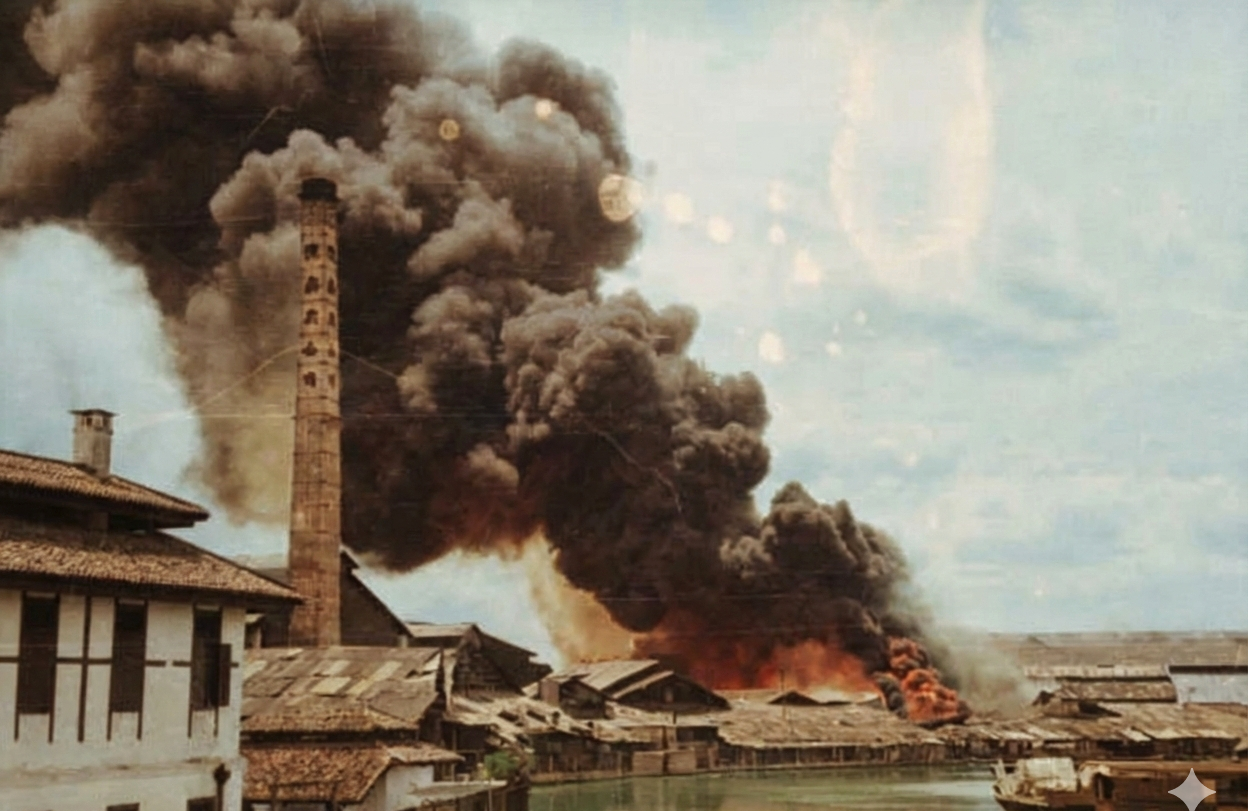
Singapore on Fire, 1942. Australian War Museum.